
.png)
Zambia’s Dwarf False Banana
Bananas are one of the most traded and consumed fruits in the world. The vast majority of the bananas that people consume are from one specific variety, the Cavendish banana, which replaced the Gros Michel in the 1950’s when the Panama disease threatened international banana production. The bananas we eat come the plant genus, Musa, native to tropical regions of Asia to Australia humans have spread and selected varieties that grow across tropical and subtropical areas of the world.
Africa also has its own genus of banana species, Ensete. The most well known of which is the False Banana, Ensete ventricosum, which forms the basis of an agricultural system in Ethiopia that harvests the starch rich tuber before flowering.
Ensete ventricosum is a large monocarpic evergreen perennial up to 6 m tall growing in upland forests, swamps or riverbanks from the Sudan south through central and southern Africa to Northern Province of South Africa.
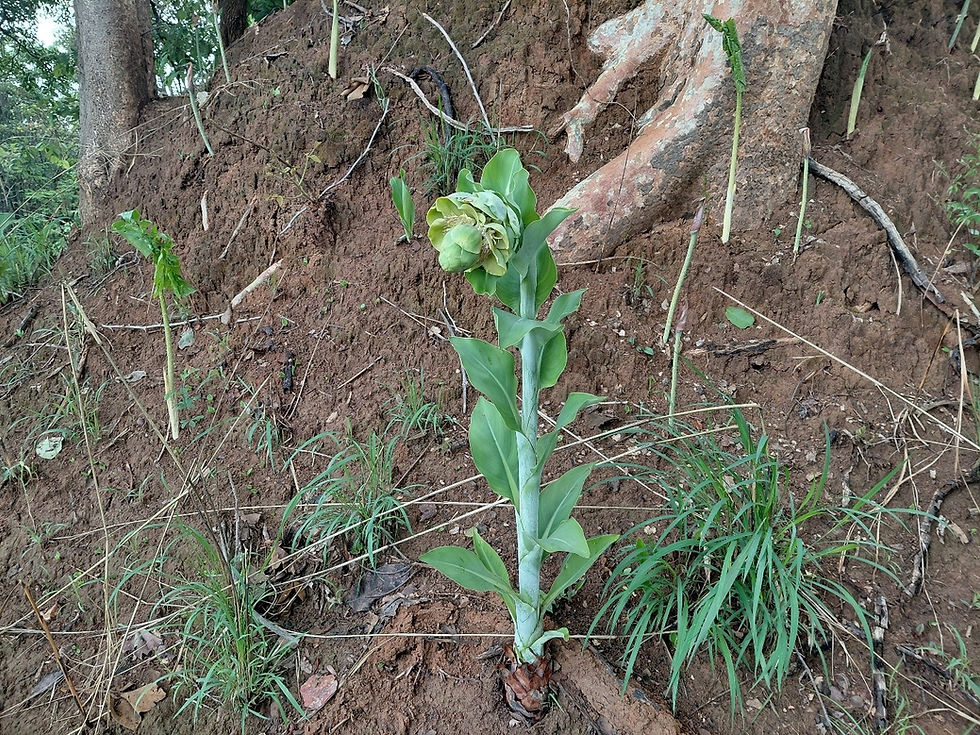
However, Zambia also has another species of Ensete, the Dwarf False Banana, Ensete homblei, found only in a band from northwestern Zambia through southern DR Congo to northeastern Zambia growing up to 1.5 m tall on termite mounds and rocky slopes in high rainfall miombo woodland. Like all other bananas, the Dwarf False Banana is a monocarpic perennial, but rather than evergreen, it is deciduous and dries back to a corm-like base to survive the long dry season. When plants are large enough, it will produce its one and only inflorescence (a monocarpic plant only flowers and fruits once before it dies) which are followed by the short and stubby banana fruits, filled with hard pea-sized black seeds.
Unfortunately, the Dwarf False Banana is not a common and widespread plant, seemingly growing on select termite mounds within the landscape.
Because of its limited global distribution and threats to its habitat from agricultural expansion and forest degradation, it has been assessed as globally Vulnerable (VU) by the International Union for Conservation of Nature (IUCN) Red List of Threatened Species.
However, we all need to do our part to help to conserve this unique and interesting species and the biodiversity it supports.


Comments